
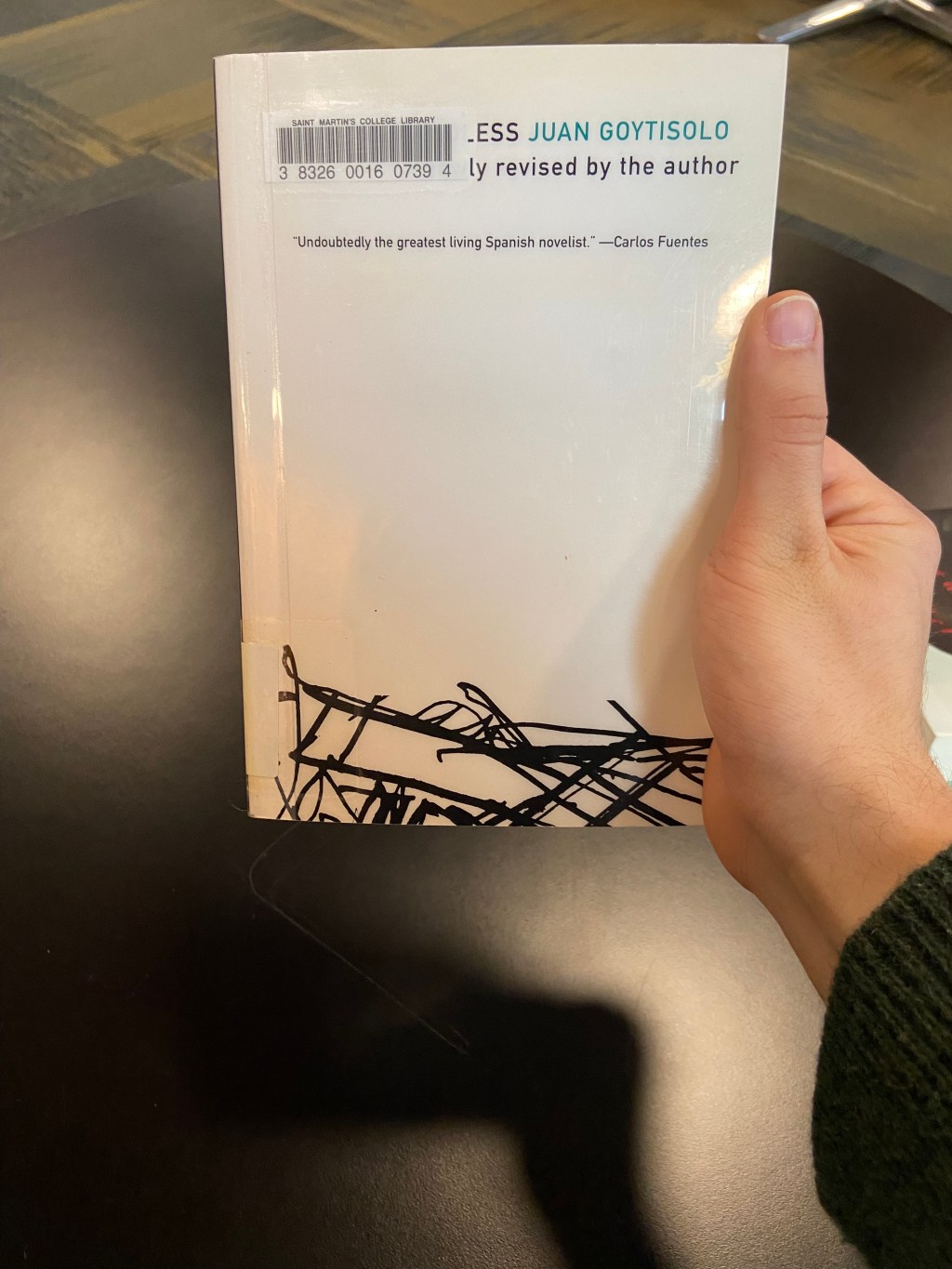
Juan the Landless (1975)
Once again, I dig into the stacks—and pull out an old literary treasure.
Juan Goytisolo’s trilogy of novels: Marks of Identity 1966, Count Julian 1970, Juan the Landless 1975, were imaginatively coined by publishers as the Alvaro Mendiola trilogy after the protagonist and narrator. In order to create both the ideal conditions for the modern artist and also to exact his revenge on his own identity, Goytisolo delves into very dark corners of the human soul. Though theoretically and thematically interlinked novels, Goytisolo’s trilogy of largely unrelated; concerned chiefly with Goytisolo’s rejection of his identity as a Spaniard, a member of the urban bourgeoisie, and of Western Civilization.
This series serves as a dissection of any aspect of the west that he could get his hands on. Though instead of being merely regulated as transgressive slop, it is a deeper meditation into the soul and interior essence of the identity of the Spaniard and the Westerner. He describes the chief goal of his series as follows: “The destruction of Spanish mythology, its Catholicism and nationalism, in a literary attack on traditional Spain.”
Born in 1933 and dying in 2017, Juan Goytisolo was a lifelong opponent of the dictatorial regime of Francisco Franco. In the 1950s, he went into self-imposed exile as an act of protest against the regime in the 1950s. The death of his mother, the imprisonment and torture of his father during the Spanish Civil War, and his family’s legacy of feudal greed, miserliness, and slave-ownership, must have left many deep scars in his psyche. His writing in the trilogy, specifically Count Julian and the topic of this review, Juan the Landless, is entirely generous and heavy-handed with its lacerations of his lineage. Juan Goytisolo’s masochism is unfettered; he’s like a monkey with a machine gun in certain regards, where everything including himself is a target. Though that’s not to say that he’s an author fueled by his wrath or anger, but instead that he is an author who perhaps had his idealism destroyed early in life, and truly never got over that pain. I feel, at least, that Goytisolo was an author who felt things very deeply, and that his writing was an attempt at restitution for the crime of his blood.
Juan the Landless is a novel which is exclusively hard to read, despite its relative brevity. Aesthetically, the text exists as a 165 page sentence, though here and there there’s a paragraph break or indented line. It is a verbal bastion bedecked in a gothic harp of elaborate and surreal cobwebs, littered with passages as devastating and horrifying as they are awe-inspiring and enviable. In one instance, there is a seamless imagining of Queen Isabella I of Spain’s reproductive organs as an Underworld portrayed as contemporary Spain built up by Cuban slaves and massacred Andalusian Muslims and Sephardic Jews. In another passage, hefty sentences cynically contemplate the earth as a gnostic game being watched over by the eye of God and the rear-end of the Devil. The spectral, the holy, the cosmic, and the illusory are all mingled with the base and the lowly.
The protagonist, Alvaro Mendiola, in a mingled state of understanding, horror, madness and nirvana, has shed himself of his name and heritage, and exists to walk aimlessly in the world, smoking hashish, and endlessly meditating on the legacy of his lineage and inheritance. He imposes an eternal exile on himself, and likens Odysseus and he to be one in the same person. With the simple line “no one awaits you in Ithaca,” he brings upon the reader the devastating idea that humanity is nothing but an eternal exile, and that all the crimes and horrors of the world are not just our punishment for leaving the garden, but the only reason that we were spawned.
Goytisolo once admitted that this novel did not achieve what he first undertook. “(I)n the case of Juan the Landless, my wish to break with artistic, social, intellectual, and moral confirmation doesn’t entirely succeed in fusing betrayal as theme and betrayal as language, the latter is too visible and undermines the desirable unity of the book.” Though that is a fair assertion coming from the man that created this book, I believe he is a bit too hard on himself. In fact, I personally believe he is very wrong.
In a similar vein to German poets and novelists like Paul Celan, Peter Weiss, W.G. Sebald, and Thomas Bernhard, who all, in an effort to reform the German language and German identity after the end of Nazi control, seriously experimented with new usages of the language in order to understand the horrors that were committed by their compatriots. Juan Goytisolo bore this responsibility on his own shoulders, and through his refurbishment of Castilian Spanish, he cemented himself as one of the pre-eminent authors, cultural critics, and prose-stylists of his generation.
This series, claimed by literary critic Ignacio Echevarria, to be one of the four most important Spanish literary events written during the Franco Regime (alongside his brother, Luis Goytisolo’s Antagonia, and Juan Benet’s Return to Región) is perhaps as relevant as ever despite how forgotten Juan Goytisolo is to modern readers, Spanish or otherwise. Juan Goytisolo once described Western Democracy as a “carousel of shallow ineffective liberalism and Trojan horses of fascism.” As recent elections in Europe and the U.S have shown, Goytisolo was not wrong in his assertion.


 Pacific Index
Leave a comment