
This special Winter Term class brings French history to life through reenactment and game play
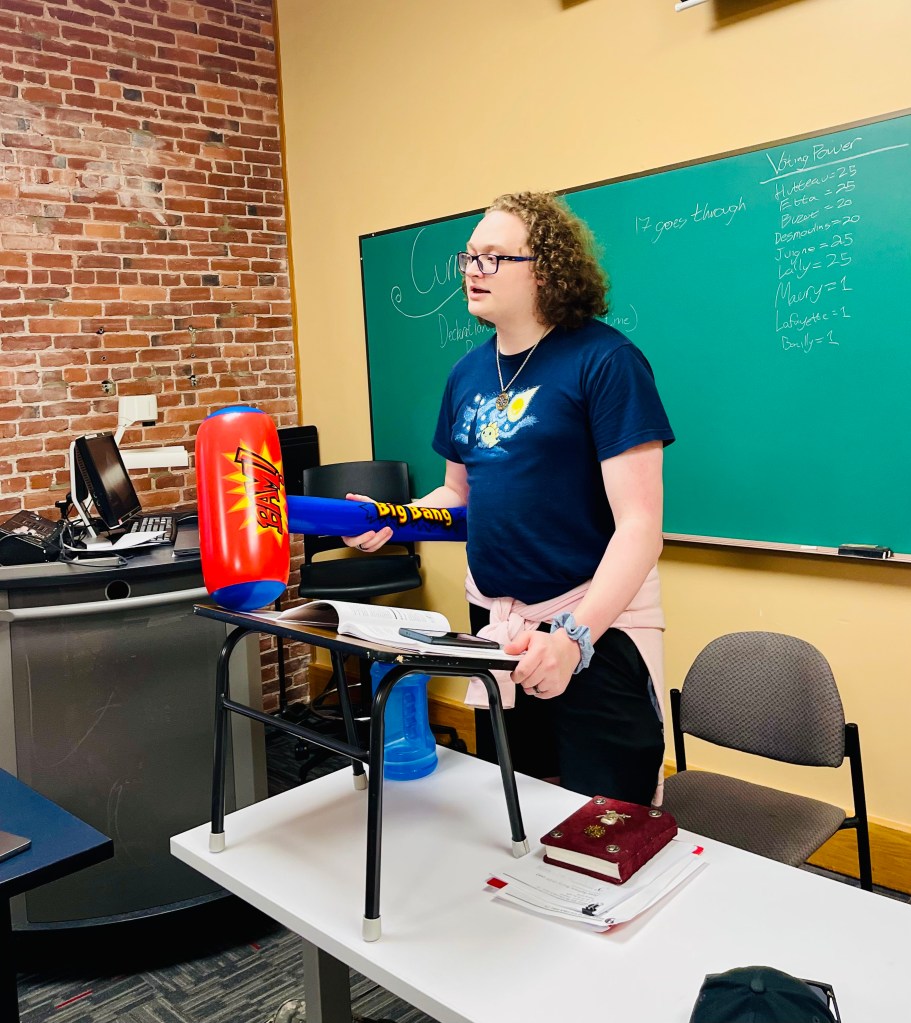
Paris is 5,000 miles from Forest Grove, and its revolution more than two centuries in the past, but Winter Term course: Revolutionary Paris, 1791 brings the excitement to life through boisterous discussion, fake executions, period piece costumes, and the roll of a die.
This past January, Professor Lisa Bradford used game techniques and interactive play to truly deliver lessons. Each student picked a historical figure from the time period and learned to embody the character. Relying only on a packet of information regarding their character, the students take the wheel and learn history through reenacting important moments that occurred in the French Revolution.
This unconventional teaching method makes for an exciting, and loud, way to learn. “I feel like it’s a little bit easier,” shared one student when asked if learning this way was better than traditional methods. “It’s more fun and more engaging.” Another student echoed this sentiment, explaining that it can be hard to get out of your shell, but once you do it’s a thrilling class to be a part of.
“There are some students who are quieter than others, but they’re still participating and doing a great job,” Professor Bradford expressed, admitting that it’s not always easy to be outspoken, but that students often adapt very well. “They get to kind of take on a character, which in a way makes giving a presentation easier for some.”
“With this, it’s student run,” Professor Bradford clarified. At the start of each class, the students gather and formally commence the “assembly.” Student Hayden Gatke volunteered to be the President of the National Assembly, otherwise known as the leader of the game. This meant that he spent all four hours and 15 minutes each class narrating and moving the game while the other students passed notes to create alliances and sometimes even plot betrayals (not unlike reality TV, 18th century-style).
The goal of the class is to create a constitution while gaining as many points for your character as possible. “There’ve been a lot of twists and turns,” Gatke said with no small amount of enjoyment. “We get taught history through active representation of our characters.”
The course opens with a few class periods spent in lecture so that students can have a solid foundation of information regarding the French Revolution. The second part of the course is when the game takes place. As the students finished the game at the end of Winter Term, it ended with several characters being faux-executed by means of an inflatable hammer and the survivors celebrating the success of their characters. The final part of the course then wraps up the history of the revolution and reflects on what it was like to actively participate in recreating all the debate and political intrigue that goes into creating a constitution.
Professor Bradford started teaching this curriculum in 2010, but what once used to be a packed class of 30 students, is now made up of less than a dozen—and her enthusiasm for the deep-learning opportunities is tinged with concern for its retention on the curriculum.
“By having class structured this way and by each person taking on a character, they get so involved and invested,” Professor Bradford revealed. “When they leave this class, they’re going to know so much about the French Revolution…and it’s embedded in them because they’ve passionately played that character.” Professor Bradford has seen evidence of this for many years. The goal now is for the enrollment to once again grow to full capacity so that all can share in the fun and unique learning experience.


 Pacific Index
Leave a comment