
Three Pacific community members challenge stereotypes about dementia through film
For Amanda Stead, speech pathologist and Associate Professor in the School of Communication Sciences and Disorders, dementia care has been a constant for almost her whole life. The condition runs in her family, and as a specialist, practitioner, and teacher, she knows almost better than anyone the way dementia patients experience life. However, her understanding may be something that the general public lacks. “What you see in a lot of other … conditions or diagnoses is that there’s these sort of positive examples out there, like, think of the ice bucket challenge for ALS, and think of the work Michael J. Fox has done for Parkinsons,” explained Stead.
However even though dementia is the fastest growing clinical population in the United States, the condition hasn’t had this same sense of awareness drawn to the cause—and this lack of representation has allowed stereotypes and unwarranted judgements to be spread about dementia with nobody to challenge them. For Stead, this issue is major, and for years, she’s had a desire to produce another narrative about dementia—specifically one through the lens of a documentary style film.
The problem? Stead doesn’t really make films.
The solution? Find someone who does!
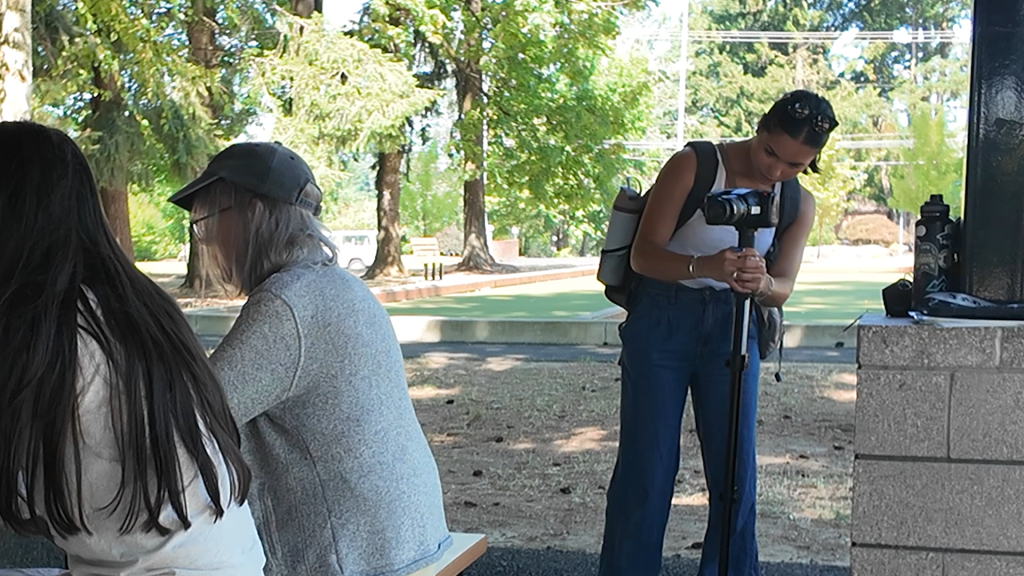
Stead approached Jennifer Hardacker, a filmmaker and Film and Video Professor at Pacific, to inquire about turning her vision into reality. Hardacker suggested that Stead present the idea to one of her media arts classes. The presentation, which Stead gave around the middle of spring semester 2025, was titled, “Dementia Has a P.R. Problem.” That presentation caught the attention of Madison Stoker, a senior film and video major. In turn, Stoker signed up as a cameraperson and editor for a documentary film, while Stead functioned as the “executive producer” according to Hardacker.
The project really started taking shape when the trio found out they had received a P.R.I.S.M. (Pacific Research Institute for Science and Mathematics) grant right before the beginning of summer. “Through the month of May, we really got our ducks in a row,” described Stead. “We really started filming in earnest in June.” The filming continued through June and July, and the project has now moved on to the editing stage, which is where it finds itself now.
For Stead, this project means more than just a simple film: It is a chance to communicate a message with the community, and hopefully the world, about how dementia patients live their lives. Dementia has a stigma that centers around hopelessness and the idea that there’s one somber outcome that can come from a diagnosis. “The world has really treated dementia like there is no hope, no solution, no pathway forward,” explains Stead. Not only is this an issue because of the way dementia gets treated publicly and in the media, it’s also an issue of the lack of needed treatment and care dementia patients receive because of the general consensus that there is little to no cure.
However, Stead shares opposing thoughts on the matter. “The reality is though… folks with dementia are living in a way that gives them kind of the highest potential for best quality of life,” claimed Stead. As she says, “We always tease, you know, we always want healthy people to live in the moment, enjoy the moment, all of this stuff. And then we have this group of people who are truly living in the moment, and instead of taking advantage of that, we’re like, oh, that’s so sad.” For Stead, the goal of the film is to communicate joy, and not the typical sadness the condition is typically associated with.
While the film is trying to change people’s perceptions of dementia, it already has changed the perceptions of some of the crew. For Stoker, the process was something completely new, a bit uncomfortable, and most of all very engaging. “Different topics of conversation would just kind of start, and they would kind of just end, and you had to be ready for that,” said Stoker, who saw herself becoming more aware as the filming process went on.
Professor Hardacker underscored that notion. “It made us really present, which I think is also the moral drive behind the film itself is about being present,” she said. “I think it makes us all want to live a bit more presently moving forward after the filming is over.” Hardacker concluded, “I have always had a little worry in the back of my head that I’m susceptible to Alzheimer’s, but now maybe I don’t have to think of it as the worst thing in the whole world that would ever happen.”
 Pacific Index
Leave a comment