
Sub-heading: Pacific’s archivist Eva Guggemos discusses the school’s collection of permanent artworks
On weekdays at Pacific, it’s typical to see students rushing through their daily lives, busy with classes, homework, friends, and sports. It’s easy to overlook anything beyond what we have to do in the moment— even things we see everyday, like paintings hanging in AuCoin.
Pacific has a large collection of permanent artwork, but beautiful as it is, it often goes unappreciated. However, archivist Eva Guggemos notes that, “Art is more than just decoration: it’s an expression of beauty, creativity and viewpoints about the world.”
Guggemos has been Pacific University’s archivist since 2011 and is an expert on the special items housed on campus. When describing her job, she explains, “I take care of the university’s unique cultural heritage: our historic documents, photographs, art, rare books and museum pieces. I also run digital projects, teach, do research and answer questions about Pacific’s history and about items in our collections.”
Though Guggemos didn’t always plan on being an archivist, she discovered this path for herself in her time at Yale. “My original goal was to be a History professor. But then I took a part-time student job working in Yale’s Manuscripts and Archives department,” Guggemos explains. She adds that it was her manager who suggested to her that she should become an archivist instead, saying it was, “…so that I could combine my interests in computers and history.”
Part of Guggemos’s responsibilities is the university’s art collection, which includes over 1,400 permanent pieces. She explains that the university has come to own these pieces through donations, commissions, or purchases. Pieces are purchased via a fund given to the university specifically for having art on campus. Guggemos adds that, “We have a committee, the University Cultural Collections Committee, that makes decisions about how to spend those funds.”
Guggemos enthuses that one of her favorite works is The Choice: Peace or War, a mural by Ray Stanford Strong from 1934. It is on the second floor of the library, and Guggemos describes it by saying, “This was a piece made during the Great Depression and you can see that the artist was trying to steer people away from the horrors of war, which he probably had lived through during World War I.” The earth is depicted in the center with opposing worlds on either side. On the left is a haunting, war-ridden world full of graves and men in gas masks. On the right is a peaceful world, showing bountiful fields and people moving into a brighter future. This mural depicts an inspiring juxtaposition of the outcomes of war and peace.

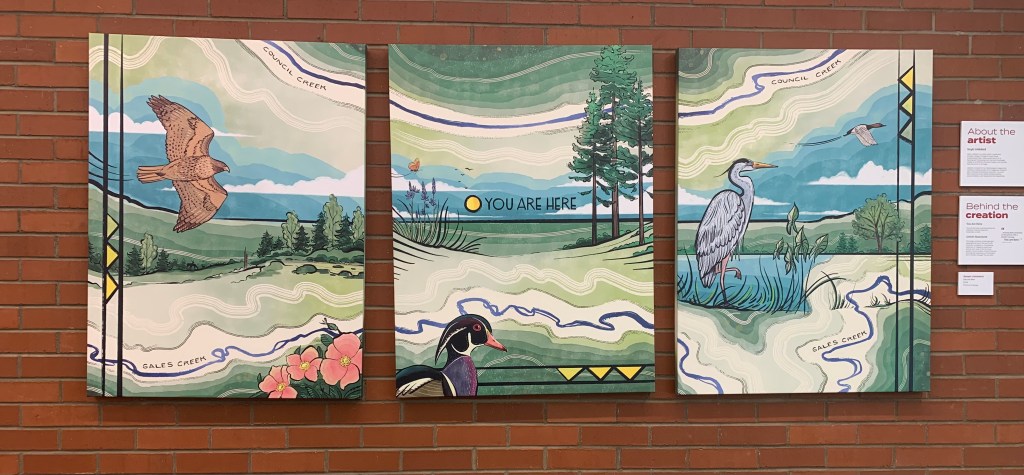
AuCoin also contains many artworks, such as the triptych You Are Here hanging at the entrance. This work is by the Native artist Steph Littlebird, a member of the Confederated Tribes of the Grand Ronde. Pacific exists on their land, and the school commissioned Littlebird to create this work. Guggemos explains that, “Her work shows that land, between two waterways, with native plants and animals.” The top and bottom segments show topographical views of Gales Creek and Council Creek, which frame a local landscape. In the center, the words, “you are here” remind us of the native land Pacific stands on, and the importance of respecting those who were here before us.
Pacific has a wide variety of global art pieces as well. One display titled Ni’ihau Shell Lei contains a beautiful Hawaiian lei made of hundreds of momi and lāiki shells that was made between 1900 and 1960. Another beautiful and historic piece is part of the Asian Art Collection. Eighteen Luohans, Scene One: Dragon Rising was made in the 18th century by Zhou Xun and is part of a series. The first one depicts a dragon emerging from a violent sea as the fishermen below runs away in fear.
Other collections include Latin American folk art, student art, professional art, the Lee Jade Collection, and the Creighton Art Collection. Many of these works are displayed around campus, and all of these works are listed on Pacific’s Permanent Art Collection website. The website is available to anyone, and you can view all permanent artworks, learn who made them, where they came from, and more. As students it’s easy to miss campus resources that aren’t required for class, but Pacific’s art collection provides valuable opportunities for students to learn. Whether it’s about history, the local area, or different cultures, the vast amount of art on campus is a beautiful way to learn something new. In regards to what students get from the art, Guggemos sums it up nicely, stating that, “…art gives depth and context to how we connect to the world— and yes, it’s beautiful, too. I hope that students are enjoying the art for the aesthetics but are also thinking about how art speaks to them.”

 Pacific Index
Leave a comment