
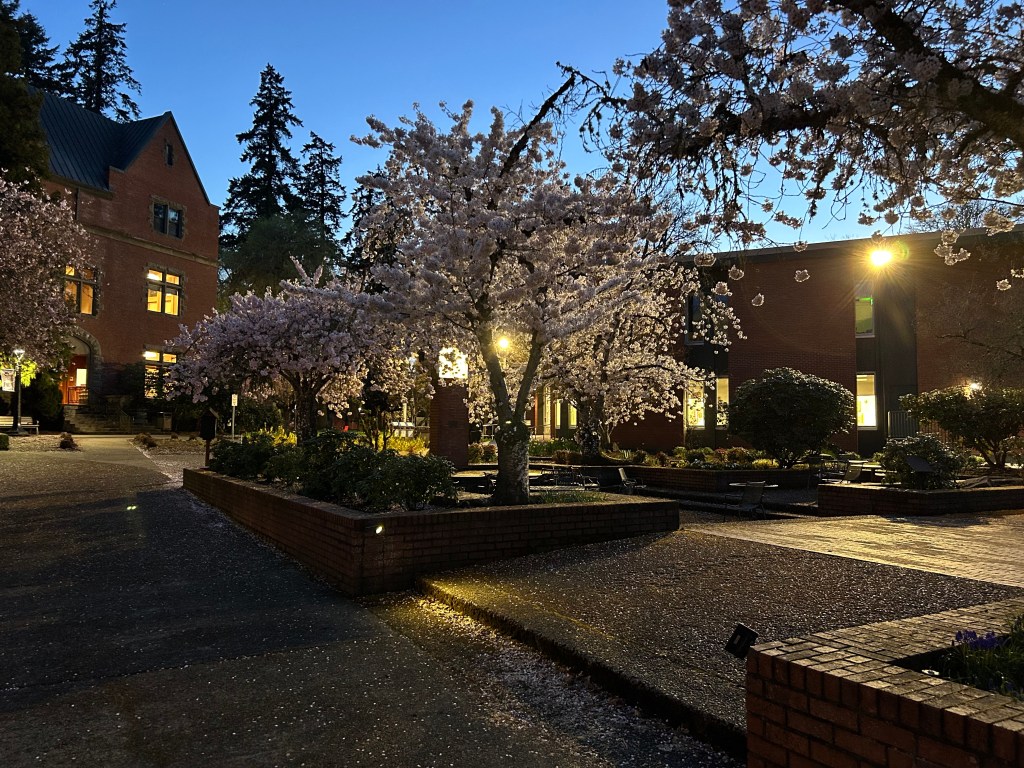
If you’ve ever walked around Forest Grove, you might’ve noticed that many old houses have placards by the front doors with the year the house was built. Some of the houses go back to the 1800s and yet now they have cars in the driveways and WiFi. So many people have lived in these houses over the years —kids, parents, grandparents—and the original homeowners wouldn’t have imagined how the world would change and how the needs of the different families would change. Over time, homeowners have had to make repairs, upgrades, and renovations to keep the homes beautiful and habitable for families whose needs are obviously really different than when the house was built.
It’s not a perfect analogy, but in a lot of ways Pacific University is like these old homes: beautiful, historic, full of stories, and with a strong foundation, yet, just like anything that’s been around a long time, it also needs the people who live in it to step back and ask how to best take care of it. Is it energy efficient? How’s the electrical and the plumbing? Do the furnishings and decor need an upgrade?
In the past year, you might’ve heard that Pacific is in the process of restructuring its academic programs, which is a little like weatherizing an older house and rearranging the furniture so the rooms are more functional for the people who live there. Last year the upper administration at Pacific—the University President, the University Provost, and the Board of Trustees—made the decision to restructure, and since then nine different committees have been rolling up their sleeves. The Undergraduate Restructuring Committee, made up of faculty, staff, and a student representative, has been working on one small piece of the larger restructuring process. We were given one main responsibility: to come up with an idea for how to organize our academic programs in a way that helps all of our programs continue to thrive and contribute to the academic life of the university while also saving money. Our guiding question is this: how can we organize our academic programs so that students and faculty can more easily connect with those who share their academic and professional pursuits?
In order to answer this question and come up with an idea that would work for Pacific, we did a lot of listening. We have a student on the committee whose perspective was essential as we imagined possibilities. Over the summer we met with students who were on campus to work or conduct summer research. This fall, we’ve sought student input at the Club Fair, at the U.C. during lunch time, and via meetings with the Student Senate. We’ve also sent out surveys to ask for feedback.
As we’ve listened to students, we’ve also sought input from multiple other groups on campus—faculty, staff, Admissions, Marketing and Communications, and current school directors. Based on all these listening sessions as well as our own research into the restructuring efforts at other universities, we designed a model that reorganized the Undergraduate College into four themed schools: School of Arts & Creative Expression, School of Culture & Environment, School of Health & Human Potential, and the School of Discovery, Innovation, & Leadership. The names are “working titles” and both the names and the missions of the schools will be finalized in the spring with input from all students.
Think of the schools as an academic “home base”. A place to meet people, explore interests, and build community before you declare a major. Students and professors can choose to be a member of any school, and can change schools if their interests change. What does organizing around a theme offer the Pacific community? Eventually, each school may offer things like: lists of Core courses connected to a school’s themes, school-specific networking events with alumni and local organizations, internship and career-development opportunities, themed capstones and summer research projects, and celebrations and events, possibly including school-specific traditions.
Importantly, the majors, minors, Core requirements, departments, advising, and graduation requirements are not changing. You still declare your major in the same way, work with the same advisors, and take the same Core curriculum.
What is changing is that students who want more community and connection around their academic interests and professional pursuits will have a clearer way to find it.
The big structural ideas are being approved now, but the programming will be developed over several years by the people who are a part of the schools. The proposal has gone to the Student Senate, Staff Senate, Faculty Senate, and the University Council for discussion and feedback. The faculty of the undergraduate college have voted to approve the overall structure. The schools will be established in the Fall of 2026, and students will begin joining schools in the
Fall of 2027. You can find full details on the Transforming Our Pacific website.
Pacific already has strong academic programs and a close-knit community. This new structure is meant to support what we already do well. It’s designed to help students build friendships, make professional connections, and find meaning in their academic journey.In other words: we’re renovating the house, not tearing it down. And like any good renovation, it’s being done with the people who live here—students, faculty, and staff—working together to shape what comes next.
Submitted by the UGDC Committee:
Shereen Khoja (Faculty Co-Chair, Computer Science), Katie Dolphin (Faculty Co-Chair, Faculty,
Kinesiology), Christian Calderon (Business), Lindsey Blem (Staff, Student Affairs), Mallory
Hiefield (Staff, Athletics), Kacelyn Kubojiri (Student), Sang-hyoun Pahk (Faculty, Sociology),
Jenna Thompson (Faculty, English), and Jaye Cee Whitehead (Dean, Administrative
Consultant)
 Pacific Index
Leave a comment