
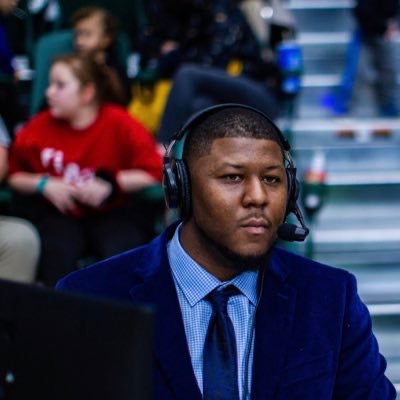
Pacific Grad DeVon Pouncey’s experience in the world of Pacific Northwest sports
DeVon Pouncey is a 2016 Pacific University graduate, where he played men’s basketball. He turned his passion for sports and storytelling, known for hosting the Wake Up and Win with DeVon Pouncey podcast, which talks about sports, politics, and culture. Pouncey is also known for his work as a television analyst for Portland State University men’s basketball and voice of Pacific University athletics. He’s also been involved with Street Roots, a weekly newspaper where he highlights social issues and community voices through journalism and podcasting.
On Tuesday, February 3, Pouncey will speak at a luncheon sponsored by the Future Sport Professionals, a new student club. The event starts at 11:45 am in AuCoin Hall 217.
Index: How did your time playing basketball shape your perspective as a broadcaster?
DeVon Pouncey: Basketball shaped my perspective on a lot of levels. As a competitor and having played through college, there are many highs and lows that come with the journey. The same could be said for an ever evolving media profession. My basketball experience helped to build me up to be able to handle the ebbs and flows of working in the media. I also realized during my student-athlete experience at Pacific that many people covering the sport either didn’t play or reflect the diversity that I got to experience while playing the sport throughout my life. So I realized there was a need for somebody like myself to have a willingness to commit to covering the game to better reflect the richness in diversity for those who actually got to experience playing the game at a high level.
Index: Can you share a defining moment in your career that made you realize you wanted to be a storyteller?
DP: It was actually a Finals project that I did in a course I took at Pacific called Politics in the Media. We had to pick a subject(s) and find mainstream media articles about said subjects and break down the articles to determine how the subjects were being framed in the media in a report/powerpoint presentation. My subjects were Marshawn Lynch and Richard Sherman of the Seattle Seahawks and how they were covered during the back-to-back Super Bowl appearances in 2013-2014. When I presented during Finals week, the presentation peaked the classes interest so much that when we got to the Q&A portion after being done presenting, I was the only presenter in the class that didn’t get an opportunity to answer any questions from my professor (Dr. Jules Boykoff) because my classmates filled the Q&A time with questions of their own because they were intrigued by the presentation. At that point things started to click for me in having a true passion for wanting to pursue media as a career rather than just studying it for the sake of a degree since I was a student-athlete.
Index: You’ve worked with Street Roots highlighting social issues in Portland. How has that experience influenced the way you approach storytelling?
DP: Working at Street Roots shaped me in a way that I truly couldn’t have imagined. As the Vendor Program Director a big part of my work was political advocacy. That advocacy also became a huge part of my coverage from a Media standpoint as I hosted the Street Roots podcast, was a media correspondent for the Newspaper and made media appearances on behalf of the organization. It led to my niche as a storyteller to have an advocacy lens. I wanted to tell stories that could potentially make a difference in the world rather than just cover what was popular or could get the most readers, listeners or viewers.
Index: What role do you think sports media can play in addressing local community issues?
DP: I think sports media can make a huge impact in addressing local community issues. Sports is one of the few industries that bring people together across differences with a common goal to win whether as an athlete, staff member or just a fan. With that said I believe the coverage of sports can reach a wide array of people and it can really help shape their perspective on the world whether that be consciously or subconsciously. An example from my own career would be covering Senator Ron Wyden during his advocacy campaign to help bring a WNBA team back to Portland, OR. It started with me covering his advocacy for the release of Brittney Griner from her detainment in Russia and morphed into advocating to bring the WNBA back to PDX. We are now expecting the Portland Fire to play their first home game as a WNBA expansion team in May of this year and Senator Wyden has publicly received props from people as high up as WNBA Commissioner Cathy Engelbert for being a vital part of making this a reality.
Index: Are there any local stories/voices you think deserve more attention in the media today?
DP: I think that the acceptance of intersectional coverage of Sports and Politics should continue to elevate. I believe that sport can speak an universal language and during these divisive times in politics it can make political coverage a bit more digestible while still having the substance necessary to be meaningful coverage.
Index: What changes have you noticed in sports media and broadcasting since you’ve started?
DP: The biggest changes I’ve noticed in Sports media and broadcasting over the years is the rise of social media and independent platforms. I think it’s a great thing from an accessibility standpoint that more people can have a voice in the sports media space. I still also think it’s important for people to be responsible with this new access and to do proper research and publish accurate and credible information rather than just to be attention seeking with their platform to try and grow an audience at the risk of diminishing their own credibility.

 Pacific Index
Leave a comment