
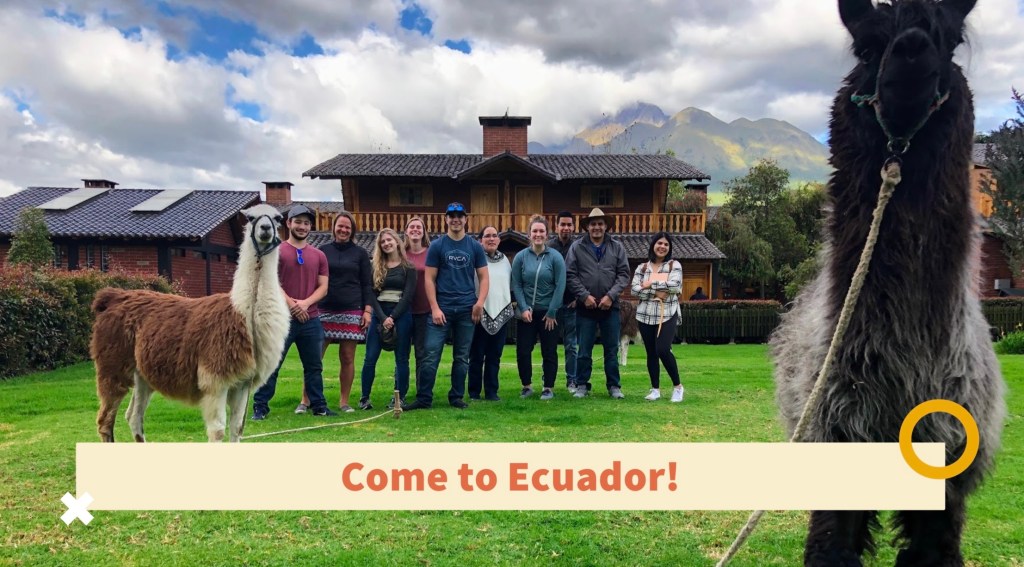
Advisor Carrie Larson and students reflect on their magical experiences in Ecuador this winter term
Pacific winter term travel courses are well-known, and well-loved, but the recent travel course to Ecuador was on a whole other level. “Every day was a different adventure,” commented the course advisor, Carrie Larson. The class spent twenty days together this January, traveling, volunteering, learning, and experiencing all facets of life in Ecuador.
For this travel course, students were split into pairs and housed with local families, which not only helped them develop their Spanish language skills, but also their cultural understanding. “They were able to see nuances in cultural distinctions between their families,” Larson explained. Student Lilia Fiorda shared, “My biggest takeaway from this course was that experiencing change and perspectives that challenge your own are critical and one of the best things you can do at any age.” The student’s reliance on their Spanish language skills along with experiencing cultural differences was daunting at times, but overall, immensely rewarding.
“Every morning, they had Spanish classes from 8:30 to 12:30,” Larson described, listing off the student’s daily program starting with school. A pausa, or pause, between classes was a treasured time for student MJ Beaumont who loved the snacks and conversation that would greet the students during each break. She explained that traditional treats like empanadas con queso, sweet bread, and cinnamon chocolate bread would await them each break. “But just a few times, we were absolutely delighted to find a tray of fresh chocolate donuts on the table,” Beaumont described. “They were incredible. Chewy, yet soft, with that just-fried melt-in-your-mouth feel. Totally different from the donuts here!” This was a time of connection for the students and ended up being her favorite part of the course. “Sitting around that huge table piled with pastries and chatting with people from all over the world,” she shared. “But we were all there, in that room, splitting donuts with each other and drinking coffee until Guadalupe— the sweetest woman ever who organized the pausa for us— announced that it was time to return to our classes.”
After the pause and classes, the group convened to eat a decadent lunch with fresh fruits, before moving onto their afternoon volunteer and city experiences. “We taught English to community kids, and we based it off of what we thought they’d be interested in,” Larson explained, sharing that English language classes in Ecuador cost money, which leaves economically challenged demographics without the resource to partake. As part of the courses volunteering project, the students worked with kids in a specifically marginalized neighborhood to teach them foundational English skills. “Even though we were only there a couple weeks, they made great connections with their kids in the service-learning project,” Larson recounted. “It was sad when we left. We made little books for them, and I printed out pictures of everybody with their students, and it was amazing how intense it was for how little time we actually spent with them.”
On the afternoons and weekends when the students weren’t in-class or volunteering, they were experiencing both the city life and wildlife. In the city they did the usual sightseeing, soaking in the historical churches and monuments. They also took a cable car so high up that they were able to glimpse the outline of the city and swing above the clouds. The group took their weekends away from the city, starting in Mindo, a biodiverse cloud forest. “We went on a hike to a waterfall, and we all laid in the river,” Larson reflected fondly, laughing at the memory. “It was freezing cold, and one person laid down and then somebody else did it, and then we’re like, okay, we all have to do it. Kind of like a cold plunge, you know?”
Beaumont also loved the time spent in Mindo, sharing a memory of the group getting in on a spontaneous dance lesson. “I think my favorite experience happened in Mindo, a cloud forest town, when we had an impromptu night out of salsa dancing,” she detailed. “It was wildly fun, dancing in the only extra clothes we brought for the weekend trip— Asics and board shorts for me— and a slice of culture that we’ll never find anywhere else.” Fiorda confirmed that dancing was often seen and practiced on their journey. “I was surprised by how often we danced while in Ecuador and how prominent it is in the culture there versus in the United States,” Fiorda commented.
Relentless, the group also partook in zip lining, rafting, and feeding hummingbirds. “You just had the little cup of nectar, and everybody was silent, and these little hummingbirds come sit on your hand…everybody loved that, and it was like meditation without meditating.” The following weekend the group made a five-hour trip over to the Amazon where they made chocolate sauce, fed wild caimans, and visited local communities. “We went to two different Kichwa communities and learned different traditional cultural things. One was ceramic making, and one was food and dance,” Larson gushed. “It was really fascinating and…it felt like a privilege.” The group also made a pit-stop by an animal reserve where animals incapable of living in the wild were taken care of. “The students loved that place,” she added. “We saw toucans, and all kinds of macaws, and parrots, and tapers, and monkeys, and all kinds of things.”
Of course, every good travel expedite has its hiccups. Larson shared one such mishap when the ramshackle boat they traversed the Amazon River in had an engine malfunction. “We got to ride back in the back of pick-up trucks, and then there was like a rainforest torrential downpour with hail, and, you know, we were just like laughing because what else?” While not everything always went perfectly according to plan, Larson attested that the group always maintained high spirits and an adventurous attitude. Only six students plus Larson made the trip to Ecuador, but the intimate group made the exploration even more personal and exciting. “They were up for anything,” Larson beamed. “They were just so much fun to do that with…I would go on a trip with them again anytime.”
Unfortunately, travel courses are only offered if a minimum number of students are enrolled. In fact, this trip to Ecuador was the first since 2020 due to a lack of student participation in the years past. The five-person minimum was just barely met this year, but next year the course will need more. “I think next year the minimum is 10, so next year we need to have more,” Larson commented. While student enrollment has had its ups and downs, the students who participated this year highly recommend taking the leap and signing up for the course. “I would absolutely recommend this course to anyone,” Fiorda expressed. “Each experience was truly unique, a once in a lifetime opportunity.”
While the course is concluded at this point, Larson wished for her students to, “…keep that sense of adventure and openness to the world— that they understand that when people operate differently, that often it’s a difference of culture and understanding…and that they keep seeing that as an asset.” The students themselves certainly understand the value of Larson’s wisdom and express much gratitude for all they learned and experienced on the trip. “I can’t speak for anyone else, but I love learning, and speaking, and improving my Spanish,” Beaumont declared. “So, this trip felt like a moment in which I could sit back, breathe, and realize, wow, I actually learned a language.”

 Pacific Index
Leave a comment