
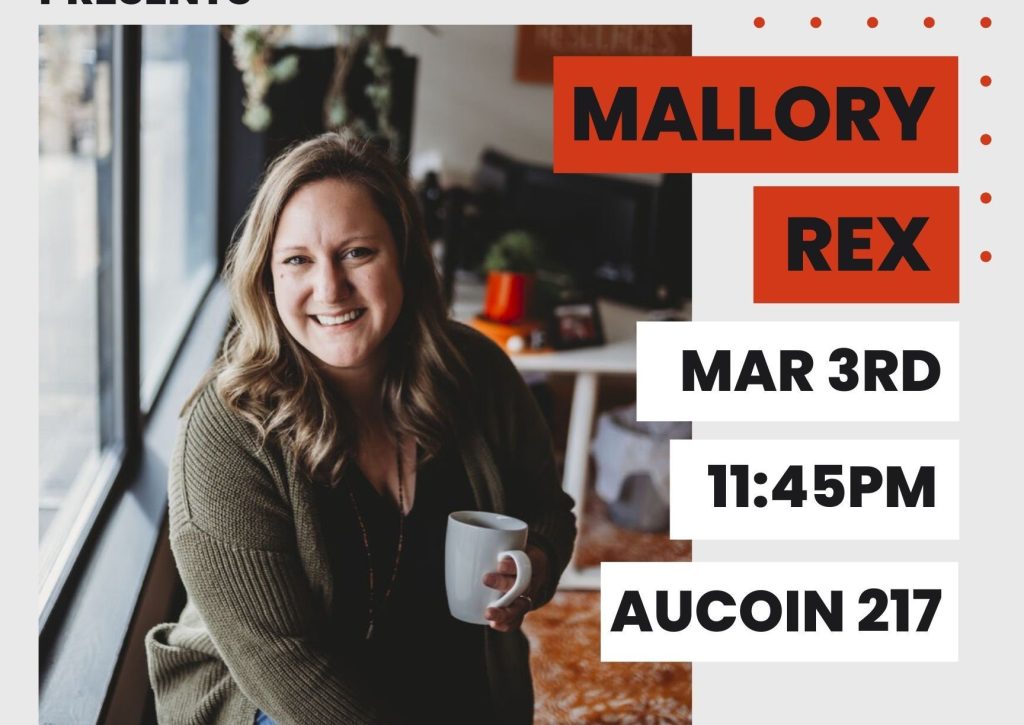
Mallory Rex comes to speak to FSP club
Mallory Rex is the Creative Director at ETZEL, a sports marketing firm. She will talk as part of the Future Sport Professionals Club’s 2026 luncheon series. Tuesday, March 3 at noon – 1 pm in AuCoin 217.
What first drew you to graphic design, and when did you realize it could be a career?
MR: I’ve always been drawn to visuals before I ever had language for it. I was the kid constantly crafting, coming up with new business ideas, and caring more about my business cards and t-shirts than the actual business. Design felt like a way to evoke feelings from people while communicating an idea or message.
I didn’t immediately see it as a career. At first it was just something I loved doing. I was a pre-veterinary medicine major for 3 years before I did a one-eighty and realized my calling was in the arts. When I understood that design wasn’t just decoration, but influence, storytelling, and emotion, that’s when it clicked. This could be a profession.
How do you translate a client’s story/goals into a brand/vision?
MR: It starts with listening. Most clients come in talking about what they want to look like, but what really matters is what they want to mean. I ask a lot of questions about the audience, emotion, messages that need to be conveyed and outcomes. What should people feel? What action should they take? What’s at stake?
From there, I look for the tension point. Every strong brand has one. It might be tradition versus innovation. Grit versus polish. Underdog versus powerhouse. That tension becomes the backbone of the visual system.
Design isn’t about making something “cool.” It’s about alignment. When visuals, messaging, and strategy are all pulling in the same direction, the brand feels inevitable. It feels like an experience more than just a set of visuals.
How does designing for sports differ from other industries?
MR: Sports design is emotional. You’re not selling a product, you’re amplifying identity. Fans don’t casually engage with teams. They wear them, defend them, pass them down to their kids.
There’s also a pace to sports that’s different: deadlines are tight, seasons move fast, and culture shifts in real time. You have to design systems that can stretch and flex across moments. A championship run feels different from a rebuilding year, but the brand still has to hold.
In sports, design lives in more places than people realize. It’s in the arena, on social, on merchandise, in broadcast graphics, events that surround games, even in the way a fan takes a photo. It’s immersive and that’s what makes it fun.
What lessons have you learned from owning/running a small business?
MR: Owning a small business teaches you quickly that talent alone isn’t enough. You have to understand pricing, contracts, boundaries, communication, and time. You’re the creative director and the accountant; the visionary and the project manager.
I’ve learned the importance of clarity when it comes to expectations, scope and value. When things go wrong, it’s usually because something wasn’t defined early enough.
I’ve also learned resilience. Some pitches don’t land and some seasons are slower than others. But if you keep at it, you see how consistency compounds. Relationships matter more than algorithms, and integrity builds a reputation that lasts longer than any single project.
What role does your community play in your creative growth?
MR: My creative community keeps me sharp and grounded. Creativity doesn’t grow in isolation. Being around other driven, thoughtful people pushes me to level up. Because I work remotely, it can be difficult at times to feel connected to my creative community, but thanks to technology (Zoom, Slack, and other apps with odd names), collaboration and challenging each other still occurs, just doesn’t take place in a board room. And honestly, my creative community holds me accountable. When people believe in you, it raises the standard you hold for yourself.
My community where I live reminds me why the work matters. Design isn’t just pixels. It affects how people experience moments, celebrate wins, and feel seen. Staying connected to real people keeps the work human.
 Pacific Index
Leave a comment