
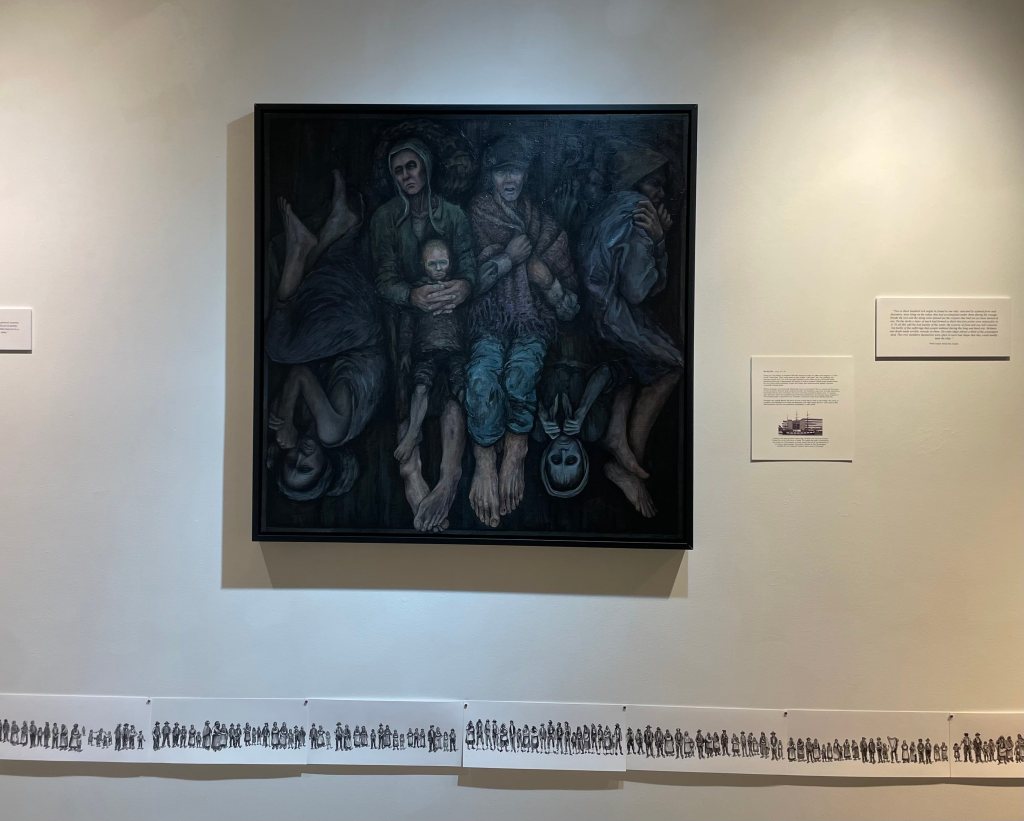
Pacific University’s Cawein Gallery presents our very own, Doug Anderson’s, exhibit, “Blight”, about the Irish Potato Famine
How much do you really know about the Irish Potato Famine?
At Pacific University’s Cawein Gallery, our very own art professor, Doug Anderson, is exhibiting his show, “Blight,” which confronts the harsh realities of this often overlooked aspect of history.
As research, Anderson took a trek on the, “…National famine way… And that was 103 miles [which] goes along the Royal Canal,” which informed much of the scenery and emotions imbued in his pieces. Retracing the steps of the 1,490 tenants displaced by the landlord, Denis Mahon in 1847, allowed Anderson to empathize with the suffering of those pilgrims and reflect on the cultural impact of the event.
Lining the bottoms of the gallery walls are 1,490 ink drawings of the people who were forced to take this pilgrimage. While Anderson intended originally to attempt a more gestural approach, flinging black and white paint at paper, he quickly realized this wasn’t the correct approach for the subject matter. “I did the birds, and you know, I liked the sort of the scratching, meticulous of the pen in the feathers and all that,” says Anderson, noting that while the stark contrast between the black and white worked for some aspects of the pieces, he thought a pop of color would be needed.
His piece, Manor House, depicts an ink rendering of the Mahon Mansion engulfing a large watercolor pig. Utilizing both ink and watercolor, Anderson uses the pig to symbolize the comparison of the consumption of wealth by the landlord Denis Mahon and the ways in which pigs were a valuable possession for Irish Tenants. By adding a splash of color to the piece, it allows for the pig to take center stage and in turn, emphasizes the deeper meaning.
The twisted and grey-toned figures of Anderson’s paintings pull the viewer into the plight of the famine itself. For the second half of his process, Anderson began working in his preferred medium; acrylic. The painted pieces reflect the humanistic aspects of the famine. His acrylic piece Emigrant pulls the viewer directly into the perspective of the many Irish tenants who followed the path. A pair of thin, grey legs stand before the viewer, with stretched and distorted shadows growing from behind the figure. It is clear that there are many following this particular emigrant, though they are not seen directly. Contrasting the grey of skin, is the bountiful green of the rolling hills, a scene that Anderson noted was very common on his walk. “They are dirty, sick, starving people. If anything, I didn’t make them gray enough, and I gave them too many clothes,” Anderson jokes. “…as the landlords were kicking people off, they converted a lot of their land from grains to livestock because livestock did not need all this care from all the people. So it was easier, and it was more lucrative.”
“I think there is one more aspect to my exhibition that I was aware of from the beginning and is important for schools like Pacific. This project is a poster child for a liberal arts education. It is all about making connections. This Famine and the way I have presented it connects many disciplines: art, history, politics, economics, biology, agriculture, social work, religion, culture and more,” Anderson clearly states.
As we all face many uncertainties in the United States, it is equally as important to understand past histories because through them we can better recognize the raging inequities and suffering in today’s contemporary world. The Irish Famine could have easily been avoided because in actuality there was enough food to feed the starving, but the British shipped it away to England to turn a profit. Anderson expresses that “knowing history is so important for informing you on what is right and wrong now, and seeing similarities between older and contemporary issues and seeing how we’ve kind of been going through these conflicts for such a long time, it just changes.” He further explains, “there’s still the same issues. We’re still starving people out as punishment for not dealing with what we want them to do… [But] They persevered when they got to, [and were] very good workers.” Now, more than ever, it is a good time to learn from history.
Anderson’s art exhibit “Blight” opens on February 7 from 4-6 pm in the Cawein Gallery.
 Pacific Index
Leave a comment