
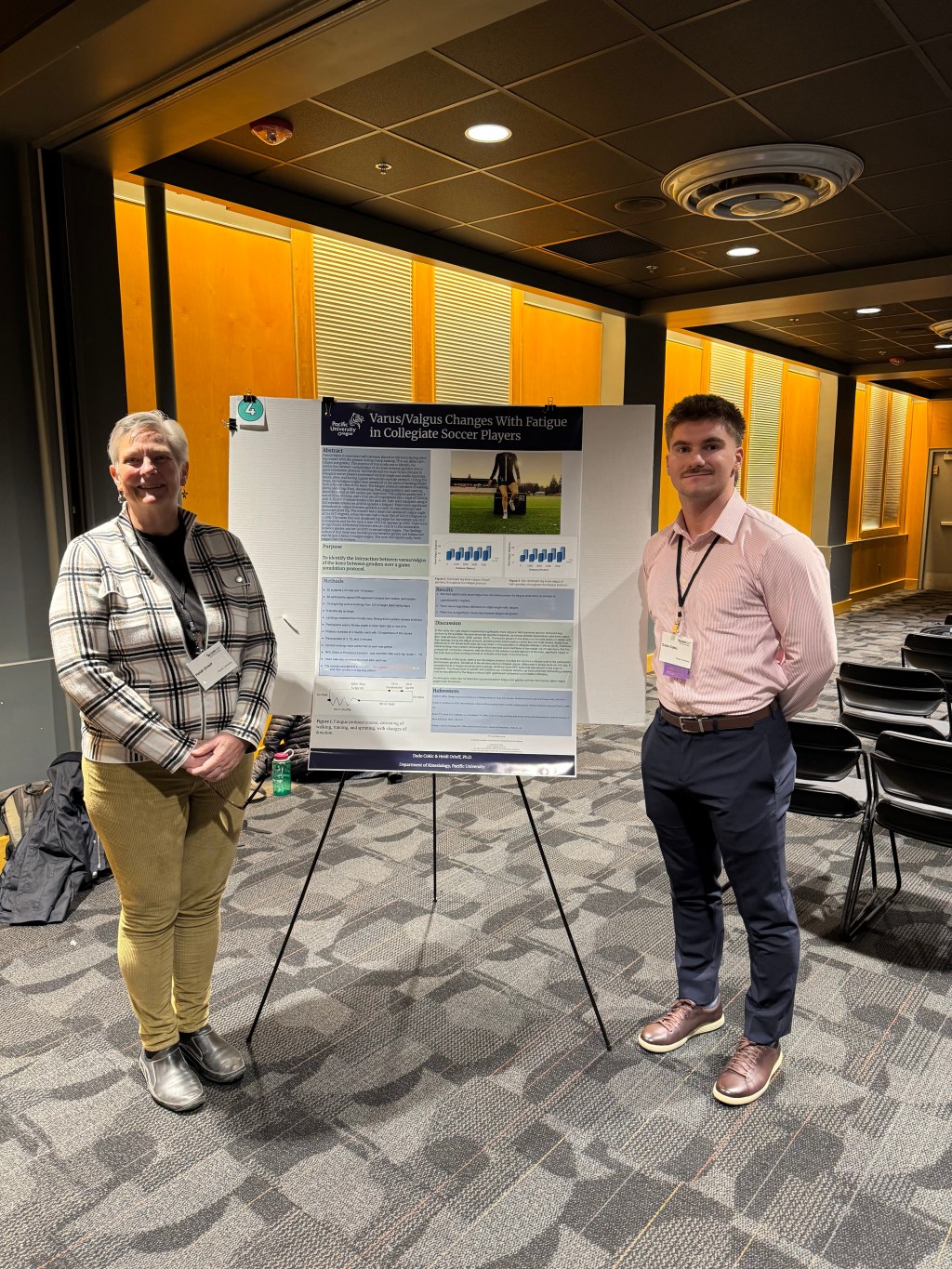
Senior Dado Cokic conducts research for his capstone project about the change of biomechanics after fatigue that causes severe knee injuries in soccer players.
The hard work and passion of an athlete are reflected not only on the field, but in the classroom as well. For senior Dado Cokic, these two worlds come together seamlessly. As senior capstone projects approach, the extensive preparation, research, and experimentation will mark the culmination of his undergraduate journey. For Cokic, this milestone also represents a meaningful step forward on his path toward a future career as a physical therapist.
A kinesiology major from Burien, Washington, Cokic dedicated much of his time to competing as a member of the Pacific men’s soccer team. As a striker known for his strength and vision for the game, he became familiar with both the triumphs and challenges that define collegiate athletics, particularly the reality of injuries. Through his own experiences and by witnessing teammates endure season-ending and even career-ending setbacks, Cokic gained a deeper understanding of the physical demands of the sport. Among these challenges, the recurring pattern of fatigue-related knee injuries stands out as a significant and often unavoidable risk for many players. That’s where he got the drive for his project.
“Over my collegiate soccer career here at Pacific, the women’s team has suffered significantly more ACL injuries over the past four years than the male players,” Cokic explained. “I know there are many factors to how these injuries occur, but I wanted to see how fatigue and landing mechanics had an effect.”
Cokic’s senior capstone is titled, “Varus Valgus Changes with Fatigue in Collegiate Soccer Players.” Varus Valgus is most commonly referred to as knee alignment, and his project was on the changes of the biomechanics after fatigue. The study was comparing men’s and women’s knee angles during a protocol that he conducted out on the field.
Cokic examined 10 of the men’s Pacific soccer players and 10 of the women’s Pacific players for his test. The fatigue protocol mainly consisted of running that lasted approximately 90 minutes to simulate playing a real soccer game. “There were breaks a quarter of the way, halfway, three quarters of the way and then before and after the vertical landings,” Cokic explained carefully. “They would practice landing on one leg and then two legs, and from those we record them to see the angle.” As time progressed and the athletes got tired the knee moved more.
Cokic shared that he did not find a significant difference in valgus of the knee with fatigue as he was hoping for or interaction between fatigue and gender. What he did find was that the male subjects did have significantly more knee valgus (knee caving in) than the female subjects did.“I expected that the women would have more changes to their knee angles as they got tired,” Cokic shared. “But we actually found the opposite effect where the male had more significant changes to their knee angles.” The increase of the knee angle after landing is an indicator of a potential severe knee injury occurrence.
Drawing from his experience as a collegiate athlete, Cokic observed numerous male and female athletes at Pacific suffer significant knee injuries. These firsthand observations led him to hypothesize that female athletes would exhibit more pronounced negative knee angles. This idea is further supported by existing research, which shows that women’s soccer players are 2.5 to 3 times more likely to experience ACL tears than their male counterparts. What can be said about his results indicating men at higher risk is that, during the test the women became more conscious of their knee movements. This heightened awareness may have stemmed from greater attentiveness to the prompts, rather than reflecting their natural movement patterns, potentially influencing the outcome.
“We can’t predict knee injuries just from how landing mechanics are and how the knee caves in, but we can decide that there needs to be an emphasis based on landing mechanics,” Cokic firmly stated. As a longtime athlete himself, Cokic shared that this project was very important to him. “I understand the severity, and long term effects of ACL injuries have on the career of an athlete, so understanding the mechanisms behind how they occur could help bring awareness to why they happen.” Taking his experience as an athlete and academic endeavors during his career at Pacific University, Dado Cokic plans to attend graduate school to earn a doctorate in physical therapy.
 Pacific Index
Leave a comment