
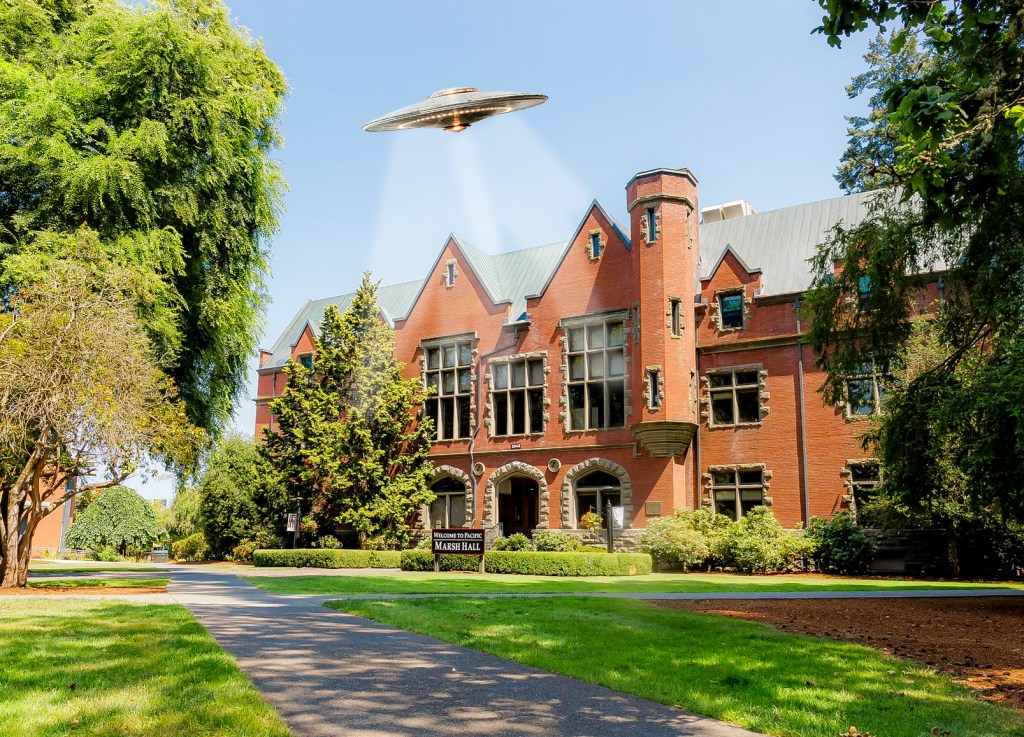
What is the Anthropology of Aliens?
If I learned one thing from my brief chat with anthropology Professor Aaron Greer, it’s that I am not adequately prepared for an alien invasion.
I have never studied how aliens behave, how they interact with each other and the world, and I most certainly have not taken a course where I could’ve learned about these things. But fortunately for a select group of first-year students this semester, their odds against extraterrestrial life might differ. This year, Professor Greer is teaching Anthropology of Aliens, a class that studies the cultures of aliens and extraterrestrial lifeforms from other worlds.
“We’re always looking at human culture, and I thought, well, that’s very human-centric of us. We should be looking at these other cultures, because we have a lot of written stories and films about them, right?,” says Prof. Greer, explaining his thought process behind teaching the course. “What we’re doing is taking an anthropological lens to really understand the values, symbols, behaviors, social practices, and those kinds of social institutions- those kinds of things to understand from these other civilizations.”
Put simply: This course seeks to understand the cultures of lifeforms out of this world. But taking a closer look, this course has a lot of interesting things to offer. Professor Greer jokes that when he asked to travel off-world for this course, the dean said it wasn’t quite in the budget yet.
“In the meantime, what we do is a lot of reading,” they state.
He mentions the class also will take a look at the cultures of the species within the movie Dune, aiming to take it apart and find their values, social practices, and the way they behave. He said the class recently watched a short film titled They’re Made of Meat, where aliens try to understand humans, and then the class uses a similar concept to understand the aliens.
Within our interview, I asked Greer if there is a “way of thinking” or prescription of the world he hopes students take away from this class. As the FYC courses this year model around “Ways of Thinking.”
After a quick, thoughtful pause, he responds, “the main goal or purpose is to appreciate just the wildly diverse ways of being. Not just in the world, but in the galaxy.” Prof. Greer goes on to talk about how being is highly individual, and my way of being might be completely different from your perceived way of being. “Culture shapes us in similar ways, but also differently based on our gender, values, and microcultures of our families.” Although not human, in his eyes, aliens are no different in that way. Culture universally shapes who we are and how we act in the world.
“Students are really enjoying the class because they’re recognizing and learning how to understand these different alien cultures,” Greer continues. In this course, they’re even going so far as to create tin foil hats to prevent unwanted alien communication. He says there is also a professional aspect to this: if aliens do invade our planet, who is going to study them? Not him, not his colleagues in other fields, but perhaps this future generation of alien experts.
“They’re going to get jobs, most likely in studying alien cultures,” Greer expresses passionately. “So I feel like the class is not just an intellectual exercise; it’s a professional exercise as well.”






Leave a Reply