
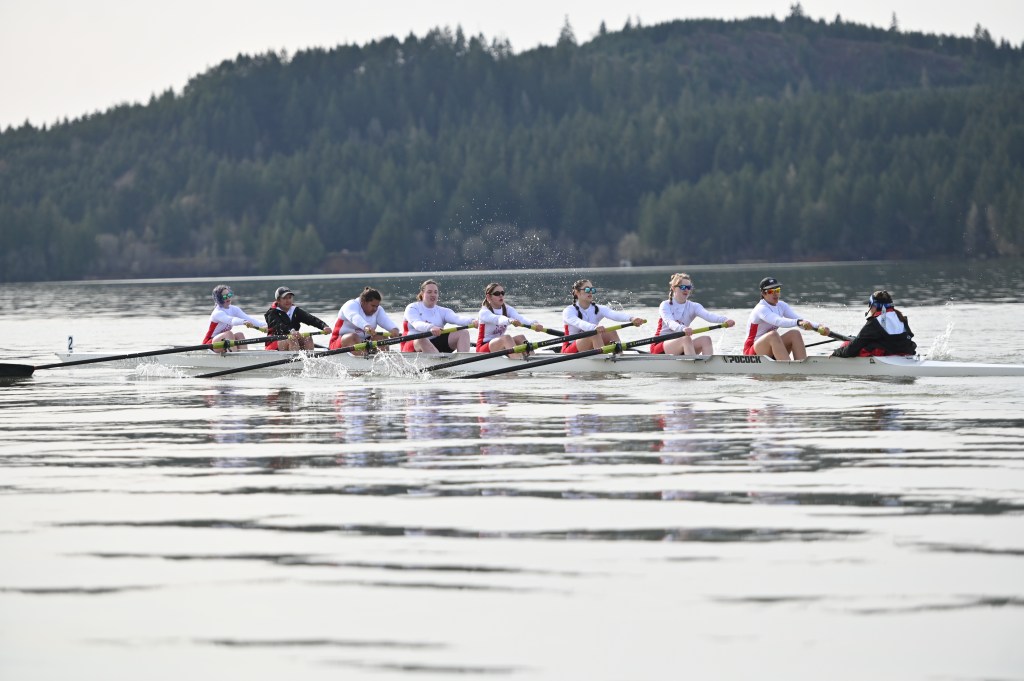
Photo taken at Small College Regatta
The strategy, processes, and goals of Boxer Rowing
It was a brisk but pleasant Tuesday afternoon when I took the scenic drive to Hagg Lake to meet with Pacific Rowing Coach Claire Ratcliff. The Boxers had just come back from an event and were unloading boats from vehicles and setting other boats into the water for the afternoon practice. I sat down with Coach Ratcliff right outside the boathouse just as the team was getting their boat out.
Rowing is unique in multiple ways compared to other sports; one being that they have two seasons, longer races in fall and “sprints” in spring. Something else unexpected is that the vast majority of the rowing team are walk-ons who have never rowed before. This can make things difficult, since rowing is a very skill-oriented sport which requires a lot of technique.
“A lot of people are learning a very technically difficult skill in a short amount of time,” said Ratcliff. This is why the fall season is so important for new rowers, because of the focus and effort that is put into learning basic technique and body mechanics.
Outside of the workout in the boat, the main training the Boxers do are on ergometers, more commonly known as the rowing machine, or cross-training such as jogging, swimming or biking. Before getting in the water, the team will do some dynamic stretching to ready their bodies. Once in the water, they’ll do a quick warmup to get themselves situated with the boat again, before doing either drilling or more aerobic work for the brunt of the practice. The boat then comes back in, with the coxswain, who is basically the navigator, having to communicate with the rest of the rowers how to get the boat back onto dry land. This can be especially difficult in inclement weather situations. The boat then gets brought back to the boathouse and the team debriefs the practice.
In rowing, there are multiple considerations taken into account when putting together a lineup. There are different types of boats and races, which require different skillsets. Take an eight (a race with eight rowers and one coxswain): Usually, the more powerful rowers will be in the middle, the “engine room,” while the more skillful rowers will be in the front (which is actually the back, as rowers sit with their backs to the bow of the boat). “They tend to be the smaller of the folks in the crew, but they have to be really, really precise with their movements,” said Ratcliff, referring to the so-called stern pair. “A small change with them can have a really big effect on how the boat sits in the water.”
According to Ratcliff, some coaches will use rowing machine scores as the primary determining factor of who participates in races. For Ratcliff however, if someone makes up for their power in technique, it can lead to a faster moving boat. Another very important thing for Ratcliff is making her rowers the best versions of themselves possible. “We coach the athlete, and not the boat, that’s something that I say a lot”, exclaimed Ratcliff. Since the coaches aren’t in the boat with the rower, it can be difficult to figure out what the cause of issues are when they arise. One of the most obvious telltale signs is a lack of synchronization. “You have to look at what each individual is doing, and ultimately if they’re matching together,” said Ratcliff.
For Ratcliff, the thing that she sees grow in rowers the most over their time at Pacific isn’t technique or power, but confidence. “Sometimes people are really timid, or they’re just starting college, and that can be a scary and lonely time on its own, but I see them building their courage,” Ratcliff proclaimed. “They are brave enough to set high goals and work toward them, and they’re confident enough to pass on their knowledge to new folks as they learn.” The upperclassmen, who were once in the underclassmen’s position, help to set a strong example of what the growth mindset looks like for a rower. Upperclassmen also help to, “set the example and show what camaraderie and care and working really really hard looks like,” says Ratcliff.
Rowing takes a lot of time and effort to get better at, with rowers practicing four times a week in the fall, and six times a week in the spring. It’s certainly a lot of hard work, but for Ratcliff, that’s kind of the entire point. “It takes time, but anything that’s going to be rewarding does, right? Like any skill that you’re learning is gonna take a lot of time to learn, to develop, and to push yourself to get even better at it.”




Leave a Reply